
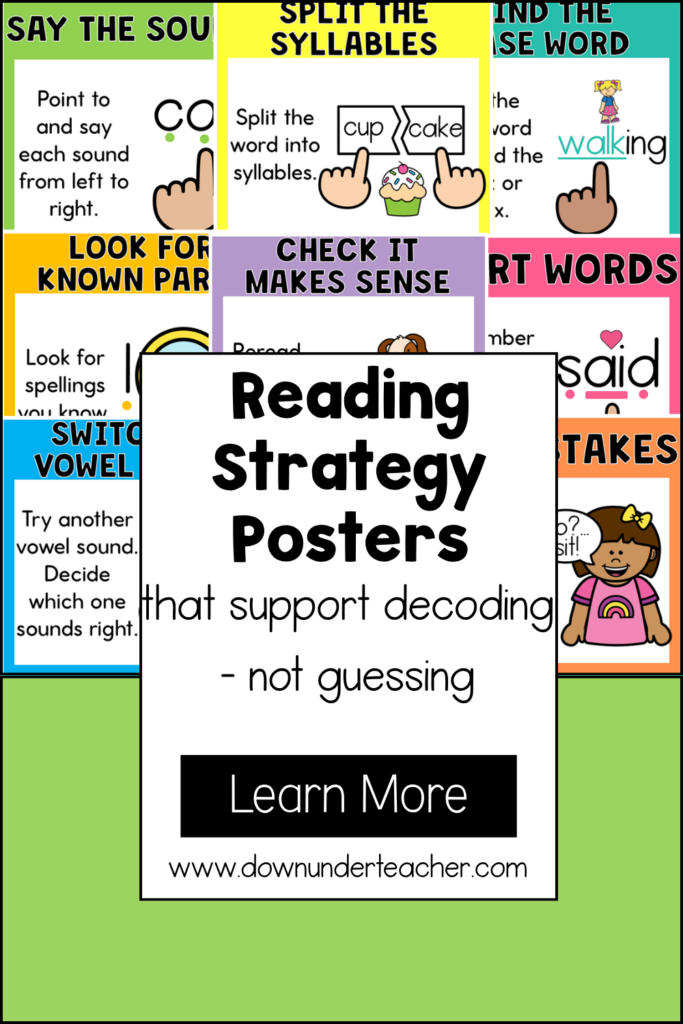
For many years, classroom reading strategy displays featured cute animal characters that reminded students to look at the picture, think about what might make sense or use the first letter to guess an unfamiliar word.
These prompts were certainly memorable, but our understanding of effective reading instruction has continued to grow. We now know that beginning readers need to look closely at the printed word and use their phonics knowledge to work out what it says.
That doesn’t mean reading strategy posters need to disappear from our classrooms. It means the prompts we display should reinforce the decoding habits we actually want students to develop.
That is why I updated my original reading strategy posters to create a more flexible, Science of Reading–aligned resource.
What Should Students Do When They Get Stuck on a Word?
When students reach an unfamiliar word, we want them to pay attention to the letters from left to right. Depending on the word and the skills they have already learned, they might:
- say each sound;
- blend the sounds together;
- look for a known spelling pattern;
- try another sound represented by a vowel;
- split a longer word into syllables;
- find a familiar base word;
- identify an irregular or “heart” part; or
- reread and self-correct if the word does not sound right or make sense.
These are not strategies to teach all at once. Each prompt should reinforce phonics, syllable or morphological knowledge that has already been explicitly taught.
Decoding Strategies Included in this Resource
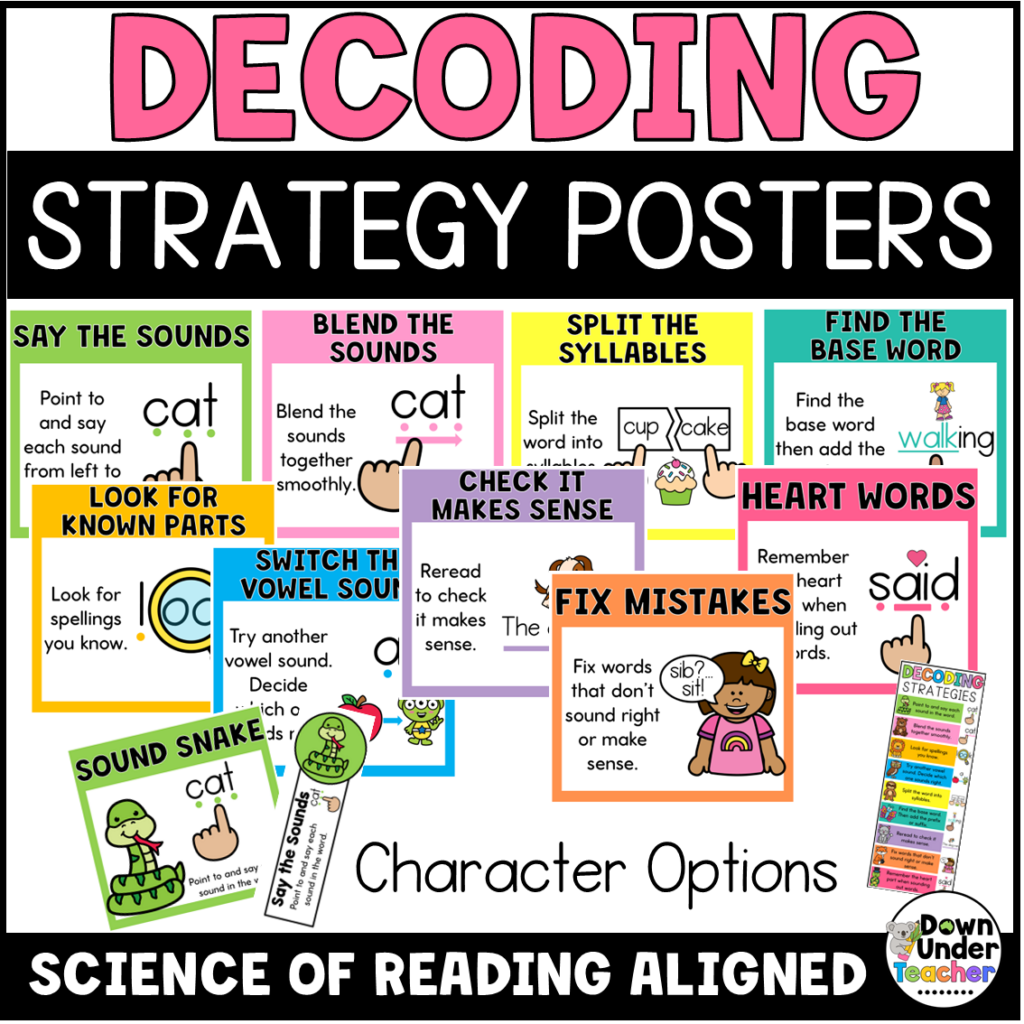
The updated pack includes posters for the following strategies:
Say the Sounds
Students point to the word and say each sound from left to right. This helps them attend to all the letters instead of guessing from the first letter.
Blend the Sounds
Students blend the sounds together smoothly to read the complete word. Continuous blending can be particularly helpful for beginning readers who find it difficult to hold separate sounds in their working memory.
Look for Known Parts
Students identify familiar spellings or chunks within a word. These should be letter patterns that have already been explicitly taught, rather than arbitrary visual chunks.
Switch the Vowel Sound
Some vowel spellings represent more than one sound. If a student accurately decodes a word but the result does not sound right, they can try another sound associated with that vowel spelling.
Split the Syllables
Students break longer words into smaller, manageable syllables before blending the whole word.
Find the Base Word
Students look for a familiar base word before adding a prefix or suffix. For example, they might find the base word walk within walking.
Check it Makes Sense
After decoding, students reread the sentence to confirm that the word sounds right and makes sense in context.
Meaning is still an important part of reading. However, we use context to confirm or correct a decoded word—not as a substitute for reading the print.
Fix Mistakes
Students learn to notice when something does not sound right or make sense, return to the word and try again.
Heart Word or Trick Words
Two options are included so teachers can choose the terminology used in their classroom or phonics program.
Both versions remind students to identify and remember the irregular part of a word while still using their phonics knowledge to decode the regular parts.
Five Reading Strategy Poster Styles are Included
I know classrooms and phonics programs use different terminology and visual supports, so I included five coordinated versions.
The pack contains:
- Beanie Baby or named animal character posters with an example and explanation
- Animal character posters without character names, with an example and explanation
- Animal character posters with an example and minimal text
- Character-free posters with an explanation and example
- Character-free posters featuring only the strategy name and example
This means you can retain the fun, memorable animal characters if they work well for your students, or select a completely character-free display.
You can also choose between more detailed posters for direct teaching and simpler versions that reduce the amount of visual information on the page.
Be sure to look through all five versions before printing so you can select the set that best suits your classroom.
Different Ways to Use this Resource
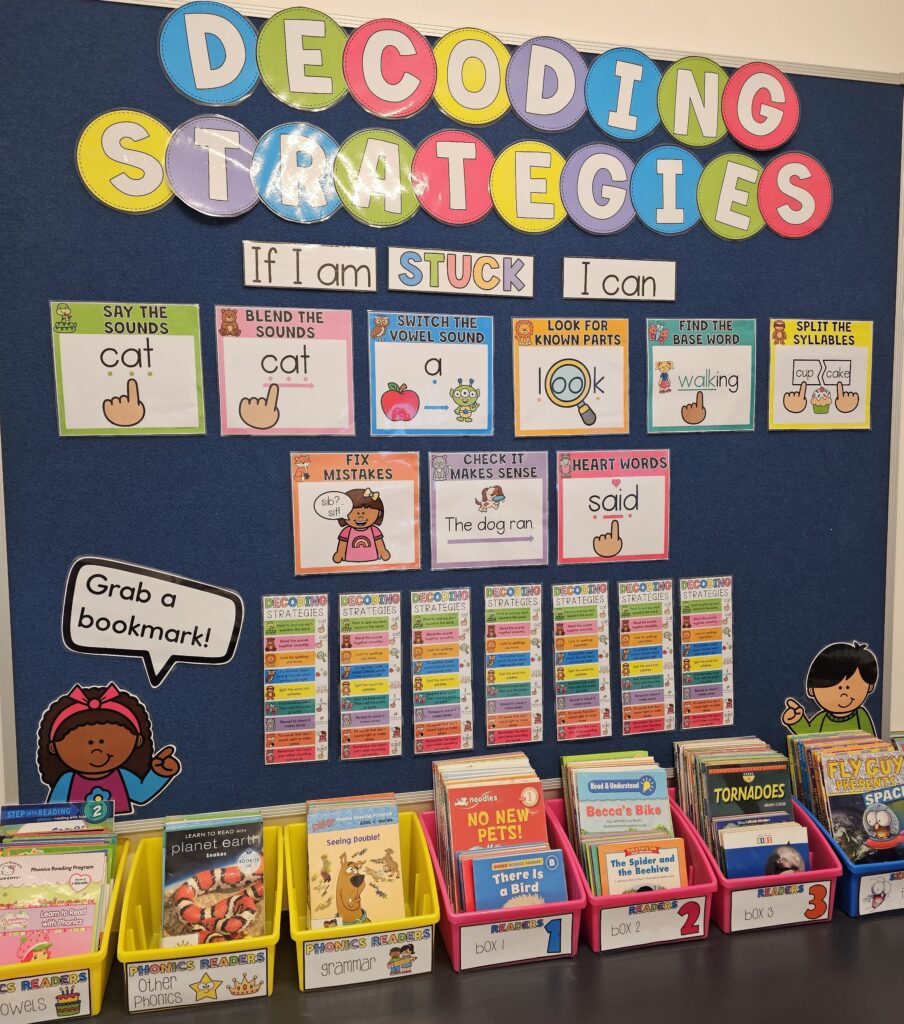
Create a Small-Group Display
I like to place a large set of posters near my small-group teaching area. I can quickly point to the relevant strategy while working with a reading or intervention group.
Place a Small Set on a Ring
Print the smaller posters, laminate them and place them on a binder ring. This creates a portable prompt set for:
- teacher aides;
- parent helpers;
- intervention teachers;
- guided reading groups; and
- individual conferencing.
It also helps all adults use consistent decoding language when supporting students.
Making Decoding Strategy Sticks
The resource includes smaller prompts sticks. Keep the sticks at your small-group table and select the one that matches the skill a student needs.
You could also place only the currently relevant sticks in a small container. As students learn additional skills, gradually add new prompts.
Use the Decoding Bookmarks
The bookmarks give students access to the prompts during independent reading without requiring a large poster to be placed in front of them.
In my classroom, I like to Velcro the bookmarks to the board so students can take one when they begin independent reading. They can also be kept in book boxes, reading folders or at your small-group table.
You can view the complete Reading Strategy Posters and Decoding Strategies Pack in my TpT store here.

7 Responses
Hi Kylie!
I followed you on Instagram – my username is lozzybeck if you want to follow me back. 🙂
Lauren
Love, Laughter and Learning in Prep!
Oh Kylie, what a trooper you are and great job to your son for “his” post. I hope your eyes are on the mend soon, I started on Instagram and then didn’t continue and I don’t know why, but now I will try to have another crack at it!
Feel better soon 🙂
Tania
Mrs Poultney’s Ponderings
Glad to have you back posting. You have been missed. Hope your eyes fully recover and quickly too. If I was your son I would have added a few words of my own for a laugh and for you to find later. Luckily you have a gem.
Julie 🙂
Mrs Stowe’s Kinder Cottage
Thanks Lauren, I’ll be sure to follow you back!
hehe, you sound like me and FB I tried, but just couldn’t continue! I like Instagram though so hopefully I’ll keep with it, we’ll see once I get back to school!
Thank you Julie! Brendan is a little gem…. most of the time!
By the way, I loved your latest watermelon post, your classroom looks awesome!
Hi,
Where can I find the posters to purchase to download?